How to Trade Meme Coins Without Blowing Up Your Account
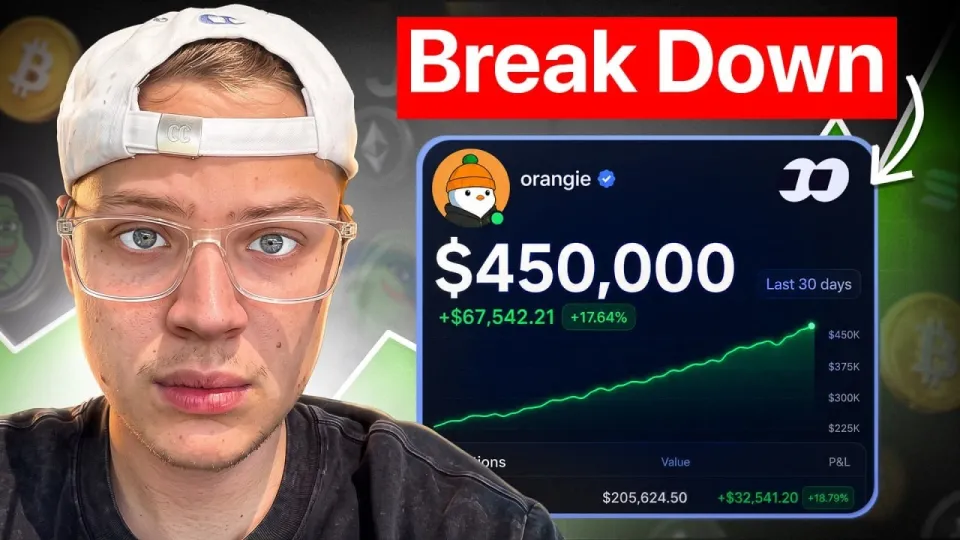
Video: How I Made $450,000 Trading Memecoins in 30 Days
You can order the same kind of articles for your own video to boost it on YouTube and Google. Just message the Telegram bot @sat_sit_bot. It writes articles around your video, embeds the video and publishes them on popular niche websites (no ads). Your first 50 articles are free.
· based on the channel Orangie Web3
Meme coin trading is a high-variance strategy where most positions lose money and a small number of winners produce the entire result, so the job is to survive long enough to be holding one of those winners. The approach shown in Orangie Web3's breakdown of a roughly $450,000 run over 30 days rests on three things: tiny fixed position sizes, fast exits on tokens that stop working, and a written plan for taking profit. If you want the same toolkit the channel uses, the Kaizen group access is sold through this checkout link.
Meme coins are tokens with no cash flow, no roadmap obligation and no floor price; their price is a pure function of attention and liquidity. That makes them a trading instrument, not an investment, and it changes how you size, enter and exit.
What a meme coin actually is and why it moves
A meme coin is a token whose value comes from community attention rather than revenue, and its price moves because of order flow, not fundamentals. On Solana, most of them launch through a bonding-curve launchpad: the token starts with almost no liquidity, price rises as buyers arrive, and once a market-cap threshold is hit the liquidity migrates to a proper automated market maker and the coin is described as having graduated.
Three mechanics drive the price action you see on charts:
- Bonding curve phase. Early buyers get the cheapest fills, but the pool is thin. A few thousand dollars can move the price 40%, in both directions.
- Graduation. Migration to a real pool brings bots, arbitrage and much deeper liquidity. It also brings the first realistic chance to exit a large position.
- Attention cycle. A meme spreads through timelines and group chats in hours, peaks, and decays. The chart rarely goes sideways for long — it either keeps attracting new buyers or it bleeds.
Because there is no valuation anchor, there is no such thing as "cheap" or "expensive" in any fundamental sense. The only questions are whether new money is still arriving and whether you can get out before it stops.
The position sizing math that keeps you in the game
The single most important decision in meme coin trading is how much you put into each trade, because your hit rate will be low and your losses will cluster. A realistic distribution looks like this: out of 20 trades, 14 go to near zero, 4 return roughly what you put in, and 2 produce multiples. If each position is 5% of your trading stack, those 14 losers cost you 70% of the stack before the winners arrive — which is why most people quit right before the outcome that would have saved them.
A workable structure for a small account:
- Fixed size per trade. Decide a dollar amount you are genuinely fine losing, and use exactly that on every attempt. No doubling after a loss.
- Cap total exposure. Keep the sum of all open positions at a level where a full wipeout of every one of them leaves you functional.
- Treat fees as part of the cost. Solana fees are small, but launchpad fees, priority fees and slippage on thin pools add up over dozens of trades.
- Never add to a loser. Averaging down on a token with no floor is how a 5% position becomes a 40% position.
The accounts that post large numbers are usually running this structure with a stack big enough that a 2x on a small position is meaningful. The percentage logic is identical whether the stack is $200 or $200,000.
How to screen a meme coin before you buy
Screening is about eliminating the tokens where you cannot win regardless of the meme, and it takes under two minutes per candidate. Most of the work happens before you click buy.
- Check liquidity depth. Look at the pool size relative to your intended position. If your buy is more than about 1–2% of the pool, your own entry moves the price and your exit will move it back against you.
- Read the holder list. A single wallet holding 20% or more of supply can end the chart whenever it wants. Bundled early buys from one entity look like many small wallets funded at the same moment.
- Confirm the contract is clean. On Solana, check that mint authority and freeze authority are revoked and that the token is not a copy of a ticker that already exists.
- Look at the age of the chart. Tokens minutes old are a coin flip on bots; tokens a few hours old with steady volume have shown there is real demand.
- Ask what the narrative is. A meme that references something currently circulating in timelines travels further than a generic dog or frog derivative.
None of this makes a token safe. It removes the subset where the outcome is decided before you arrive.
Entry, exit and taking profit in tranches
Exits decide your result far more than entries do, because an unrealized gain on a token with thin liquidity is not money yet. The pattern that works is mechanical: buy a fixed size, sell a portion into the first strong move, and keep a runner only with money you have already mentally written off.
A concrete framework:
- First tranche at 2x. Sell enough to recover your initial position plus costs. From that moment the trade cannot hurt you.
- Second tranche into strength. Sell another slice as the price accelerates, especially when volume spikes and the chart goes vertical — that is when buyers, not sellers, are easiest to find.
- Runner with a hard rule. Keep a small remainder with a stop at breakeven or a fixed target, and accept that it may round-trip to zero.
- Exit on thesis break. If volume dries up, the pool thins, or the wallets that drove the move start distributing, leave. Do not wait for the price to "come back".
The uncomfortable part is that the biggest winners are usually the ones where you sold too early. That is the cost of a system that also gets you out of the losers.
Common questions from newer traders
Newer traders tend to hit the same three walls: speed, losing streaks, and the feeling that everyone else is winning. The pace of a fast-talking explainer can make the process look simpler than it is, and the honest answer is that the first weeks are mostly about learning the interface and the failure modes with small money.
On losing streaks: a run of ten red trades is normal, not evidence that the strategy is broken. What matters is whether each loss was the size you planned. If losses are getting bigger, the problem is sizing, not the market.
On speed: you do not need to catch the first minute of a launch. Waiting for graduation or for a few hours of consistent volume removes most of the bot-dominated phase and costs you some upside.
On group chats and calls: being in a room where other traders share ideas shortens the learning curve, but it also creates the temptation to buy things you have not screened. Treat every call, including the good ones, as a candidate that still has to pass your own checklist.
Useful links
- Kaizen group access and checkout: https://whop.com/checkout/plan_GTFkEFh0JFpU8?a=orangie
- FOMO trading platform referral: https://fomo.family/r/orangie
- Orangie Discord community: https://discord.gg/memecoins
- Instagram: https://www.instagram.com/orangieyt/
The takeaway
Meme coin trading is a probability business, and the $450,000 figure in Orangie Web3's 30-day experiment is the output of a system, not a signal to copy. The repeatable parts are boring: fixed small positions, a screening checklist that filters out the unwinnable tokens, and a tranche-based exit plan that converts paper gains into realized ones. The unrepeatable part is the sequence of winners, which nobody can schedule. If you take one thing from the breakdown, take the sizing rule — it is the only variable fully under your control, and it decides whether you are still trading when the next big winner appears. Access to the channel's group and tools is available through the Kaizen checkout.
Key takeaways
- Orangie Web3 reports turning roughly $450,000 in profit from meme coins inside a 30-day window, trading mostly Solana-launched tokens.
- Meme coin trading is a hit-rate game: most positions go to zero, and a handful of winners have to pay for everything else.
- Position size is the main control you have — small enough that five losses in a row do not end the experiment.
- Liquidity, holder distribution and whether the token has graduated from a launchpad matter more than the meme itself.
- Selling into strength in tranches beats waiting for a single perfect exit that rarely comes.
Questions & answers
How much money do you need to start trading meme coins?
You can start with a small amount, but it has to be money you can lose entirely without changing your life. The important number is not the total but the size of each individual position — it should be small enough that a run of ten losses in a row still leaves you able to keep trading.
Is it realistic to turn a small account into six figures with meme coins?
It happens, but it is a tail outcome, not a plan. Large reported gains usually combine a meaningful starting stack, dozens of attempts and a couple of extreme winners. Treating a six-figure result as the expected case is how people oversize and lose the account.
Why do most meme coin trades end at zero?
Because there is no cash flow or floor value to anchor the price. Once attention moves on and new buyers stop arriving, liquidity drains and the token has nothing to hold it up. That is why the exit plan matters more than the entry.
Should I follow calls from group chats and Discord servers?
Use them as a source of candidates, not as instructions. Every call still has to pass your own checks on liquidity, holder concentration and contract safety, and it still gets the same fixed position size as any other trade.
Source: How I Made $450,000 Trading Memecoins in 30 Days · Markdown version